













Car enthusiasts know that the gap between a smooth, confident stop and a heart-stopping moment of delayed braking often comes down to one overlooked component: the brake disc. For anyone who follows the world of automotive performance and maintenance closely, understanding what a brake disc actually does — and what really causes it to fail — is far more nuanced than the common ‘just replace it when it’s thin’ advice suggests. The myths surrounding brake discs are surprisingly widespread, and clearing them up can make a genuine difference to both safety and running costs.
A familiar scenario reveals a bigger problem.
Picture this: a driver notices a faint judder through the steering wheel every time they slow down on the motorway. A friend tells them it’s ‘just surface rust — drive it hard and it’ll sort itself out.’ A quick search online suggests the discs are ‘probably warped.’ A local mechanic says they might need balancing. Three opinions, none of them quite right.
This is exactly where brake disc myths take root. The judder was caused by uneven thickness variation (UTV) in the disc — a measurable, real phenomenon that has nothing to do with warping in the classic sense. It doesn’t disappear with motorway driving, and wheel balancing won’t touch it.
Getting to grips with what brake discs actually are — and what actually goes wrong with them — matters for safety, not just curiosity.
Brake discs are precision components, not simple metal rings.
The most persistent myth is that a brake disc is essentially a passive lump of iron that just gets squeezed. In reality, a disc must dissipate enormous amounts of heat, maintain dimensional stability under repeated thermal cycling, resist corrosion, and provide a consistent friction surface — all simultaneously.
Ventilated discs, for example, have internal vanes between two friction faces specifically engineered to channel airflow and manage heat. The metallurgy, vane geometry, and surface finish all affect braking performance directly. For anyone sourcing replacement parts, a broad catalogue such as www.autodoc.co.uk lists discs by vehicle specification so that the correct type — solid, vented, or drilled — can be matched precisely to the application.
Treating a brake disc as a generic consumable is the first step toward choosing the wrong replacement.
Warping is widely misunderstood.
Ask ten drivers what causes brake judder and the majority will say ‘warped discs.’ Metallurgists and brake engineers, however, point out that true thermal warping — a disc permanently bending out of shape from heat — is exceptionally rare in road cars under normal conditions. Modern cast iron discs are relatively resistant to permanent deformation at the temperatures generated in everyday driving.
What actually causes judder in the vast majority of cases is uneven disc thickness, or deposits of brake pad material transferred unevenly onto the disc surface. Both produce the same symptom — a pulsing or vibration under braking — but the cause is different and so is the correct fix.
Measuring disc runout and thickness variation with a dial gauge and micrometer tells you far more than any visual inspection.
Surface rust is normal, but not always harmless.
A light film of rust on a brake disc after a vehicle has stood overnight is completely normal and clears within the first few brake applications. This is one of the most reliable myths in circulation: ‘My discs look rusty, something is wrong.’
However, there is a meaningful difference between superficial oxidation and deep pitting or corrosion that has compromised the friction surface or reduced the disc below its minimum thickness. The minimum thickness (also called the discard thickness) is cast or stamped onto most discs by the manufacturer. Once a disc reaches this dimension — through wear or corrosion — it must be replaced, regardless of how it looks from a distance.
Ignoring this figure because ‘the disc looks fine’ is a genuine safety risk.
Replacing discs and pads together is not just upselling.
A commonly repeated accusation is that garages insist on replacing both discs and pads at the same time purely to inflate the invoice. In many cases, the recommendation is technically sound.
New pads bedding against worn discs cannot achieve full, even contact across the friction surface. The new pad material may transfer unevenly, accelerating exactly the kind of thickness variation described above. Worn discs also have a different surface profile from new ones, prolonging the bedding-in period and potentially reducing initial stopping power.
There are situations where pads alone need replacing — for example, when discs have significant remaining life and a consistent, smooth surface. But the default assumption that ‘pads and discs together is a scam’ is simply wrong.
Drilled and grooved discs are not automatically better for road use.
Performance-oriented drivers often assume that cross-drilled or grooved discs offer superior braking for everyday driving. The reality is more conditional.
Drilling and grooving aid gas and heat dispersal under very high-load conditions, such as track use. On public roads, where sustained heavy braking is rare, the practical benefit is marginal. Drilled discs also introduce stress concentration points around the holes, which can make them more susceptible to cracking under repeated thermal cycles — particularly if the material quality is not matched to the application.
For most road cars, a quality solid or ventilated disc in the correct specification outperforms a poorly matched ‘performance’ disc every time.
Bedding in new discs is a step many drivers skip entirely.
One of the most consequential myths is that new brake discs are ‘ready to use straight out of the box.’ They are — up to a point. But a proper bedding-in procedure significantly improves long-term performance and reduces the risk of uneven pad transfer.
Here is a straightforward bedding-in sequence used in professional workshop settings:
- Drive at moderate speed (around 50 mph) and apply the brakes firmly but not to full lock, slowing to approximately 10 mph. Release and allow the brakes to cool for at least 30 seconds before repeating.
- Repeat this deceleration sequence around eight to ten times.
- Avoid coming to a complete stop with hot brakes during this phase — keeping the vehicle moving prevents pad impressions being transferred to one spot on the disc.
- After the bedding sequence, allow the brakes to cool fully before driving normally.
- Avoid heavy or prolonged braking for the first 200–300 miles wherever possible.
Skipping this process does not mean the brakes will fail immediately, but it does reduce the consistency of the friction film that develops between pad and disc.
Buying brake discs online requires checking more than just the price.
Online parts markets have made it easier than ever to source brake discs, but they have also made it easier to buy the wrong part or a disc that does not meet the vehicle’s specification. Key checks before purchasing include confirming the outer diameter, thickness, bolt pattern, and hub bore diameter — all of which vary between models and even between trim levels of the same car.
The AUTODOC Marketplace is one platform where selected, verified third-party suppliers list brake components alongside AUTODOC’s own stock, giving buyers a wider product range at competitive prices within a familiar, structured environment. For Marketplace orders, fulfilment, invoicing, and customer service are handled by the respective third-party seller, with AUTODOC monitoring supplier performance against defined service standards.
Checking compatibility filters carefully and cross-referencing the vehicle’s registration or VIN before ordering remains essential regardless of which platform is used.
These warning signs are worth taking seriously.
Not every brake disc problem announces itself dramatically. The following indicators are genuinely worth investigation rather than dismissal:
- Steering wheel vibration specifically during braking, not at constant speed — points to disc thickness variation rather than wheel balance.
- A grinding or metallic scraping noise that persists beyond the first few seconds after standing overnight — may indicate pad wear past the friction material or disc surface damage.
- Pulling to one side under braking — can signal a sticking caliper but also uneven disc wear between the two sides of an axle.
- A burning smell after normal driving without heavy brake use — suggests a caliper not fully releasing, which accelerates disc wear and heat build-up.
- Visible deep scoring or a pronounced lip at the disc’s outer edge visible without removing the wheel — indicates the disc may be at or near its wear limit.
| Disc condition / scenario | Recommended action | Typical service interval or threshold |
|---|---|---|
| Light surface rust after overnight standing | No action needed — clears within a few brake applications | Normal occurrence; monitor only |
| Disc thickness approaching manufacturer minimum | Replace disc (and assess pads) | Check annually or every 20,000–25,000 miles depending on use |
| Disc thickness variation causing judder | Measure with micrometer; replace if variation exceeds ~0.01 mm | Check whenever judder or pulsing is felt underfoot |
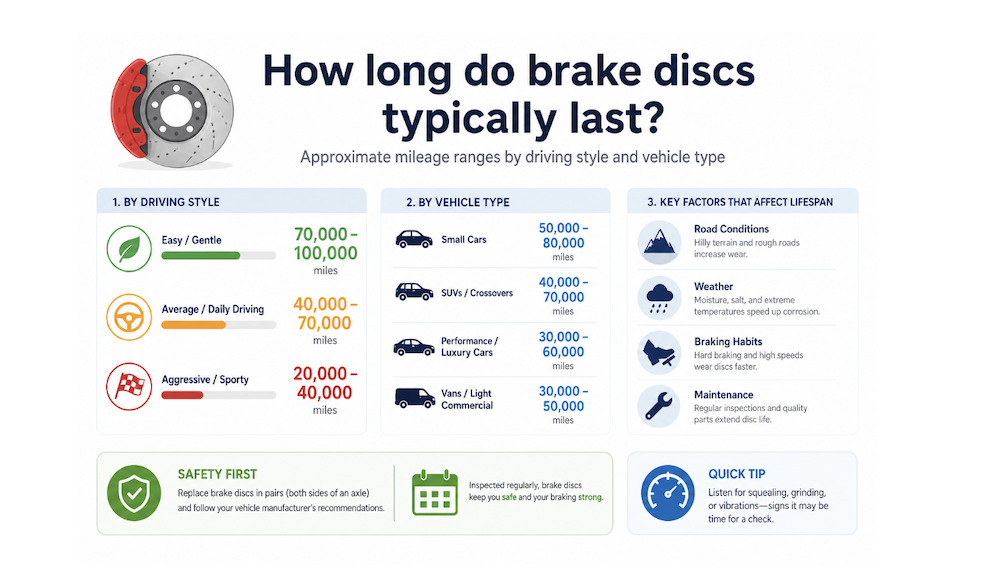
| Pad and disc replacement — general road use | Replace both on the same axle simultaneously | Pads typically every 25,000–50,000 miles; discs every 50,000–70,000 miles (use-dependent) |
| Post-replacement bedding-in | Follow staged deceleration sequence | First 200–300 miles after fitting |
| Visual inspection for cracking (drilled discs) | Replace if cracks extend beyond hole perimeter | Every service or when removing wheels for other work |
One question often surfaces once the myths are cleared away: ‘Do I really need to replace both discs on an axle, or just the worn one?’ The consistent workshop answer is both. Braking performance depends on balanced deceleration across an axle — fitting one new disc against one worn disc introduces an asymmetry that can cause the vehicle to pull under braking and puts the new component under unequal stress. The cost saving of replacing only one disc is real, but so is the handling compromise that follows. On an axle that sees equal load and equal wear, treating the two discs as a matched pair is the approach that holds up technically — not as a rule invented to sell more parts, but as a straightforward consequence of how balanced braking actually works.