















Most drivers pick up 5W-30 because the shelf label looks familiar, but few know why it is the right choice or when it isn’t. Get this wrong and you risk engine wear, a failed MOT, or a voided warranty.
5W-30 is a multi-grade synthetic engine oil used in a wide range of modern petrol and diesel engines. The numbers tell you exactly how it behaves. “5W” means the oil stays thin enough in cold conditions to circulate immediately on a winter start, which is the moment when most engine wear actually happens. The “30” tells you its viscosity at normal running temperature, around 100°C, where it needs to hold a stable film over pistons, bearings and camshafts. That combination makes 5W-30 a practical all-year choice for the UK climate, from frosty January mornings to slow summer motorway queues.
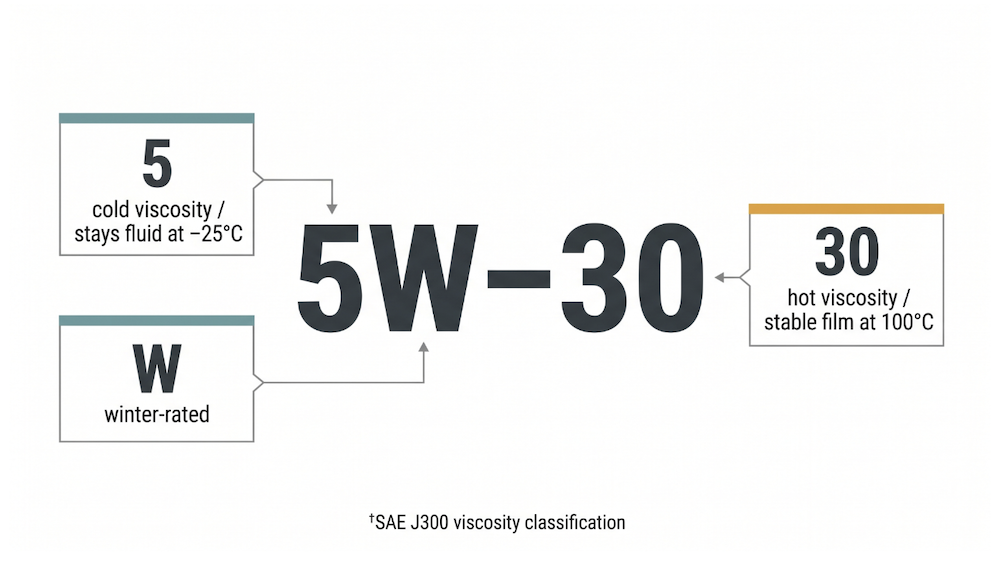
What the numbers on the label actually mean. The “5” describes cold-weather flow, “W” confirms winter rating, and “30” tells you how the oil behaves at full operating temperature. All three together define whether the oil suits your engine.
Why Viscosity Matters More Than The Brand
Engine oil doesn’t just lubricate. It cools, cleans and protects. When oil is too thick for cold starts, it takes too long to reach critical components. When it’s too thin at high temperature, the protective film breaks down. 5W-30 sits in the middle ground that most modern engine designers have built around, which is why it’s the factory specification for so many cars sold in Britain over the past 15 to 20 years.
But viscosity grade is only half the picture. The specific formulation, its ACEA classification, API rating and any OEM approval, is what actually determines whether the oil is safe for your engine.
Which Cars Use 5W-30
5W-30 is specified across a broad range of vehicles but is especially common in family hatchbacks such as the Ford Focus, Vauxhall Astra and Volkswagen Golf. These efficient petrol and diesel engines were engineered around thinner oils that reduce internal friction and support better fuel economy.
Executive saloons and SUVs follow the same pattern. Many BMW, Mercedes-Benz and Audi models, particularly diesels from the last 15 years, require long-life 5W-30 formulations built for extended service intervals. Popular crossovers like the Nissan Qashqai and Kia Sportage also fall into this category, as do light commercial vans including the Ford Transit. Some hybrid vehicles still use 5W-30, although newer models are increasingly moving to thinner 0W-20 grades for maximum efficiency.
When 5W-30 Is The Wrong Choice
5W-30 is not a universal answer. High-performance and track-focused cars typically need a thicker grade, 5W-40 or even 10W-60, to handle extreme temperatures under hard driving. Classic cars built before the 1980s require specialist oils like 20W-50 with different additive chemistry suited to older engine materials. Using modern low-viscosity oil in an older engine can cause leaks and accelerated wear.
What Diesel Owners With A DPF Must Know
If your diesel has a Diesel Particulate Filter, and most diesels registered after 2009 do, you cannot use just any 5W-30. You need a low- or mid-SAPS formulation that matches the required ACEA C-category specification for your engine. Using a standard 5W-30 in a DPF-equipped car increases ash buildup inside the filter, shortens its life and can trigger warning lights and expensive regeneration failures. Always check the ACEA class and OEM approval before buying.
How To Read The Label Correctly
On any engine oil bottle you will find several codes worth understanding. The SAE grade is the viscosity, for example 5W-30 or 0W-40, and it should match your handbook exactly. The ACEA rating is the European quality classification: A-class oils are for petrol engines, B-class for diesel, C-class for engines with aftertreatment systems like DPFs. Most modern diesels need a C2 or C3 oil.
OEM approvals are manufacturer-specific standards printed on the label. VW 504.00/507.00, BMW Longlife-04, Mercedes 229.51: these matter as much as the viscosity. If your car requires one of these, using an oil without it can invalidate your warranty and cause real damage.
Mineral, Semi-Synthetic Or Fully Synthetic
Most 5W-30 oils sold today are fully synthetic, and for good reason. Mineral oils are cheaper but less stable. They thicken in cold weather and degrade faster under heat. Semi-synthetic blends improve on this but still lose viscosity over time, leaving deposits inside the engine. Fully synthetic 5W-30 protects better across temperature ranges, lasts longer between changes and handles modern turbo and direct-injection engines far more effectively.
Hydrocracked oils sit between semi-synthetic and full synthetic. They are priced lower than full synthetics but degrade more quickly under extreme temperature swings, which makes them a poor choice for high-mileage or performance use.
How Often To Change Engine Oil
For most modern cars running 5W-30 full synthetic, the manufacturer service interval is typically between 10,000 and 15,000 miles under normal driving conditions. Under heavier loads such as frequent towing, short urban trips or extended idling, expect to change it closer to 6,000 to 8,000 miles. Even if you don’t cover the mileage, change the oil at least once a year.
Check the level every 1,000 miles with the dipstick. Never let it drop below the minimum mark, and never overfill past the maximum. Both cause real problems.
When changing oil, always fit a new filter at the same time. Pre-fill the new filter with around 200ml of fresh oil and lightly coat the rubber seal before fitting.
Where To Buy
AUTODOC stocks a wide range of 5W-30 oils from brands including BMW TwinPower Turbo, Febi Bilstein, Mobil and VAG-approved formulations. You can search by registration plate to filter oils that match your specific engine specification, which is useful if you are unsure which ACEA class or OEM approval applies to your car. Always cross-check the result against your vehicle handbook before purchasing.
AUTODOC also runs its own marketplace, connecting British buyers with selected third-party sellers directly through the same website and app. The platform launched in the UK in February 2026 and already lists over 1.2 million offers across spare parts, vehicle electronics, accessories and security products. Every seller on the marketplace is held to defined performance standards and service-level agreements, and AUTODOC monitors seller activity and steps in when a customer isn’t getting adequate support. It’s a wider selection than a traditional parts retailer, with the same searchable catalogue and vehicle-specific filtering you’d expect from AUTODOC.