











There is no fixed mileage written into law, but most specialists point to somewhere between 80,000 and 120,000 kilometres as a realistic service life under normal driving conditions. That figure drops significantly on rough roads, with heavy loads, or with an aggressive driving style.
The more reliable signal is behaviour, not mileage. And the stakes are higher than most drivers assume. Safety tests conducted by Monroe showed that worn shock absorbers can extend stopping distance by up to 7.6 metres on a dry road more than the full length of a car. Separate simulation research found that suspension faults caused by worn dampers increase stopping distance by around 40 percent, even with ABS active. That is not a comfort issue. That is the difference between stopping in time and not.
Industry estimates suggest roughly one in four cars on the road is running on worn shock absorbers most drivers simply adapt their driving style to the gradual change and never notice.
The infographic below summarises the six most common warning signs. Each one can appear on its own; if you notice two or more at the same time, the dampers should be inspected without delay.
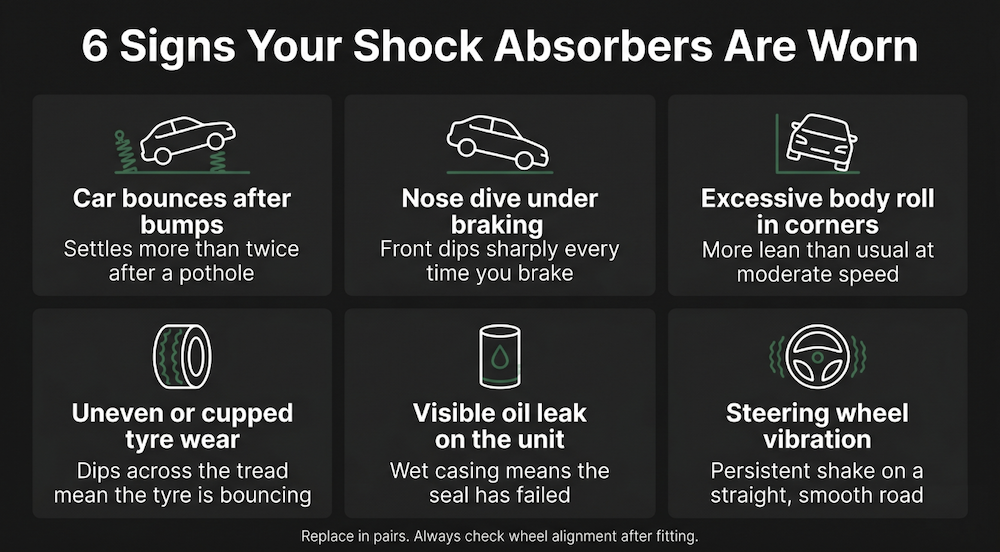
- Car bounces after bumps. Press down firmly on a corner of the car and let go. It should settle in one or two movements. If it keeps bouncing, the damper is not doing its job.
- Nose dive under braking. If the front of the car dips heavily when you brake, the front shock absorbers are likely worn.
- Body roll in corners. More lean than usual when turning, especially at moderate speeds, points to degraded damping on the outside wheels.
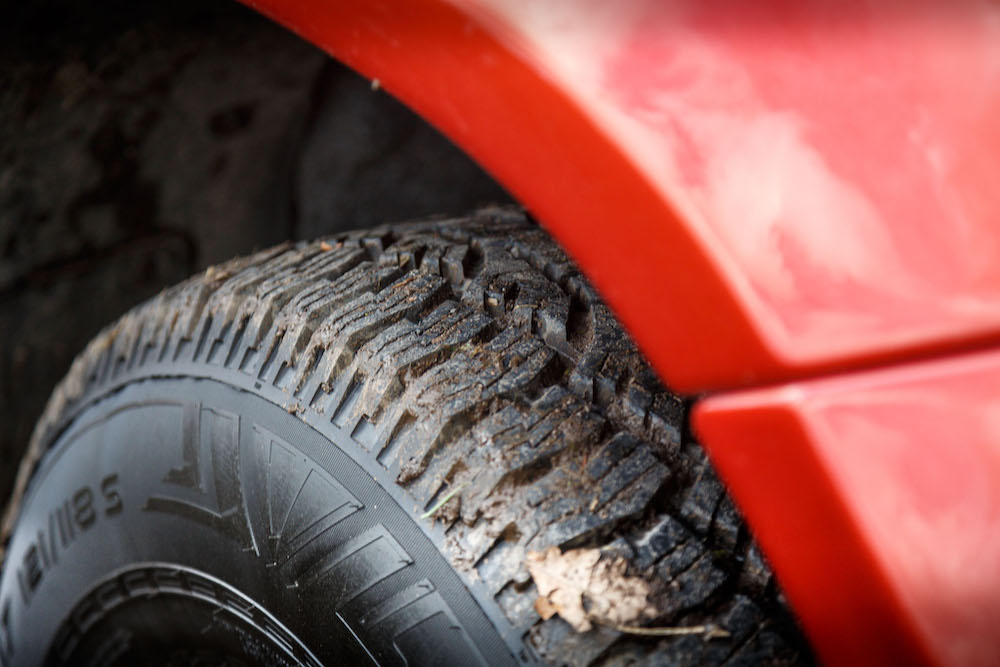
- Uneven tyre wear. Scalloped or cupped wear patterns across the tread are a strong sign the tyre is bouncing rather than rolling consistently. Research from tyre manufacturers suggests vehicles with worn dampers can lose up to 25 percent of tyre service life as a result. This is often the first visible symptom, and the one most people attribute to something else.
- Visible oil leaks. A wet or oily outer casing on the shock absorber means the seal has gone. The unit needs replacing.
- Vibration through the steering wheel. On a straight road, consistent vibration can indicate the front dampers are no longer controlling wheel movement properly.
What it costs to replace shock absorbers in the UK
Parts prices vary considerably by brand and vehicle. For common models such as a VW Golf or Ford Focus, a pair of quality aftermarket shock absorbers for one axle typically runs from around £40 to £150 depending on brand. Premium brands sit at the higher end.
Labour costs in the UK generally add £80 to £200 per axle depending on the vehicle and the garage’s rate. Total cost for a full replacement on one axle, parts and labour, usually falls between £120 and £350 for mainstream cars, more for German premium brands with complex suspension setups.
How to choose the right shock absorber for your car
The main decision points are your car’s make and model, how you drive, and your budget.
For daily driving on standard suspension, a gas-pressure twin-tube unit matching original equipment specification is the practical choice. Sachs and Meyle units, for example, are developed to German VDA testing standards and go through individual performance and leak testing before leaving the factory.
If your car has an adaptive suspension system such as Volkswagen’s DCC or similar setups from BMW and Audi, electronic dampers are required. Monroe’s CVSAe units are designed specifically for these systems and allow the car’s control unit to adjust damping in real time.
For vans, MPVs, or cars regularly carrying heavy loads, a frequency-selective design like Koni’s Special Active range is worth considering. These adjust automatically to different load conditions without sensors or software, which makes them a practical choice for vehicles that vary significantly between empty and loaded.
Worn shock absorbers are not an abstract safety concern. They increase stopping distances, reduce tyre contact with the road, and make the car less responsive when it matters most. Around one in four cars on British roads is running on dampers that are past their best — most of those drivers have no idea. If yours are approaching high mileage or showing any of the symptoms above, checking them costs nothing. Ignoring them for another season might.